Domain-Driven Design with
F# and EventStore
Lev Gorodinski
gorodinski.com
@eulerfx
Goals
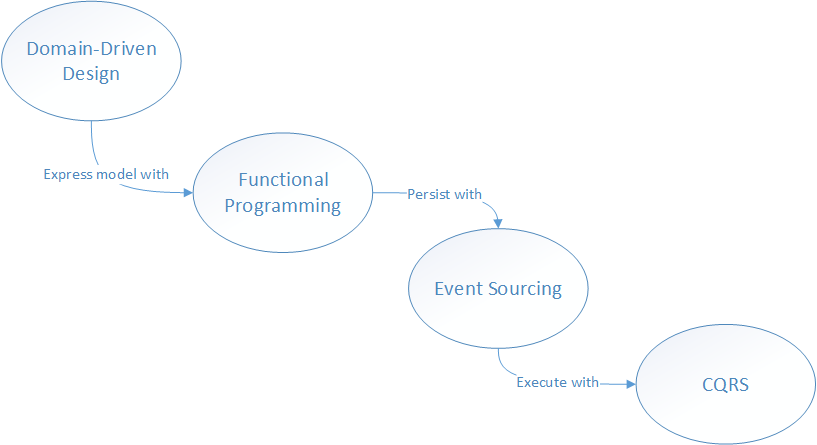
- Go beyond OOP
- Learn F# / Functional Programming
- Learn EventStore / Event sourcing
- Supple design
The Domain
SaaSOvation / Collaboration
Forum Aggregate
Behaviors
- Start
- Assign Moderator
- Change Description
- Change Subject
- Close
- Re-Open
C#
public class Forum : EventSourcedRootEntity
{
	public void AssignModerator(Moderator moderator)
	{
		AssertionConcern.AssertArgumentNotNull(moderator, "The moderator must be provided.");
	    AssertOpen();
	    Apply(new ForumModeratorChanged(this.tenantId, this.forumId, moderator, this.exclusiveOwner));
	}

	void AssertOpen()
	{
	    if (this.closed)
	        throw new InvalidOperationException("Forum is closed.");
	}

	void When(ForumModeratorChanged e)
	{
	    this.moderator = e.Moderator;
	}
}
public abstract class EventSourcedRootEntity : EntityWithCompositeId
{
	readonly List<IDomainEvent> mutatingEvents;
	readonly int unmutatedVersion;

	protected void Apply(IDomainEvent e)
	{
	    this.mutatingEvents.Add(e);
	    When(e);
	}

	void When(IDomainEvent e)
	{
	    // dynamic dispatch
	    (this as dynamic).When(e);
	}
}
Issues
- Verbose
- Not POCO
- Double dispatch voodoo
- Misuse of inheritance
- Conflation of state and identity
F#
type State = {
    moderator      : Collaborator;
    description    : NonEmptyString;
    closed         : bool; }
Record Type
- Immutable by default
- No inheritance
- Structural equality, comparison
Events & Commands
type Command =
    | AssignModerator of Collaborator
    | ChangeDescription of NonEmptyString

type Event =
    | ModeratorChanged of Id * Collaborator * ExclusiveOwner
    | DescriptionChanged of Id * NonEmptyString * ExclusiveOwner
Union Type
- Mutually exclusive, named cases
- Similar: closed class hiearachy, C union, enum on steroids
- Pattern matching
let apply state = function
    | ModeratorChanged (_,moderator,_) ->
    	{ state with moderator = moderator }
    | DescriptionChanged (_,desc,_)    ->
    	{ state with description = desc }
Pattern Matching
- Switch statement on steroids
- ...lots of steroids
- Customizable
let exec state =
    let assertOpen = validator (fun _ -> state.closed <> true)
    	["Forum must be open."] state
    function
    | AssignModerator moderator -> assertOpen <?> [ModeratorChanged(...)]
    | ChangeDescription desc -> assertOpen <?> [DescriptionChanged(...)]
Improvements
- Brevity
- Explicitness
- Uniformity
- Single responsibility
- Static verification
- Cohesion
Benefits for DDD
- Focus on behavior
- Declarative
- Assertions
- Side-effect free
- Closure of operations
Challenges
- New paradigm
- Different paradigms collide for attention
- Less tooling support
- C# interop can be less than pleasant
- Missing some advanced functional features
Event Sourcing
want to learn event sourcing? f(state, event) => state
— gregyoung (@gregyoung) March 17, 2013
AHA!
let apply state = function
    | ModeratorChanged (_,moderator,_) -> { state with moderator = moderator }
    | DescriptionChanged (_,desc,_)    -> { state with description = desc }
Event Sourcing
Capture all changes to an application state as a sequence of events.Martin Fowler
Capture allchanges to an application statebehaviors as a sequence of events.
Reconstitution
Replay all past events to bring aggregate into current state.
Aggregate Abstraction
	type Aggregate<'TState, 'TCommand, 'TEvent> = {
		zero : 'TState;
		apply : 'TState -> 'TEvent -> 'TState;
		exec : 'TState -> 'TCommand -> 'TEvent; }
Replay
      let events = load (typeof<'TEvent>,id)
      let state = events |> Seq.fold aggregate.apply aggregate.zero
EventStore Integration
  let load (typ,id) =
      let slice = conn.ReadStreamEventsForward(id,1,Int32.Max,false)
      slice.Events
      |> Seq.map (fun e -> decode(typ,e.Event.EventType,e.Event.Data))
Event Persistance
  let commit (id,expectedVersion) e =
        let eventType,bytes = serialize e
        let meta = [||] : byte array
        let data = EventData(Guid.NewGuid(),eventType,true,bytes,meta)
        if version = 0 then
          conn.CreateStream(id, Guid.NewGuid(), true, metaData)
        conn.AppendToStream(id,expectedVersion,data)
Projections
- Project stream onto new stream
- State
- Declared with JavaScript
- Simple read-models
- CEP
Read Model Projection
fromCategory('Forum').foreachStream().when({
  $init: function() {
    return { description: null, moderator: null };
  },
  "ModeratorAssigned": function (s, e) {
    s.moderator = e.body.moderator;
    var streamId = "ReadModel-" +
          e.streamId.replace("Forum-", "");
    var eventType = e.eventType + "_ReadModel";
    emit(streamId, eventType, s);
  },
  "DescriptionChanged": function (s, e) {
    s.description = e.body.description;
    var streamId = "ReadModel-" +
          e.streamId.replace("Forum-", "");
    var eventType = e.eventType + "_ReadModel";
    emit(streamId, eventType, s);
  }
});
Challenges
- Less tooling support
- Non-trivial shift in data modelling
- Queries must be implemented separately
- Eventual consistency
- Lack of referential integrity
- Schema maintenance, refactoring
Why F# / Functional Programming?
- .NET, VisualStudio
- Multi-paradigm
- Powerful type inference
- Language oriented
- Better coupling characteristics
- Smaller, more numerous types
- Function as unit of coupling
- More explicit, declarative
- Pattern matching
- Avoid nulls
- Isolate, minimize state
- OOP patterns taken care of
- Draw on math research
Why EventStore / event sourcing?
- Immutable, preserve information
- Uniform
- Append only
- Natural model of reality
Acknowledgements
- Vaughn Vernon
- Paul Rayner
- Community